Yoga power: A Bridge to the World of Higher Consciusness
I’m not exactly sure who and what kind of person you are, but if you
have been following my blog for some time now, surreptitiously or
otherwise, then I presume we are both, one way or another, trying to
reach for the same thing, i.e. higher consciousness. That is why in this
article, I’m going to try to help stretch your view by telling you what
I know about yoga, its different branches, its practices, its role in self-empowerment, and its connection to the world of higher consciousness.
 I’m
aware that some people are unable to show any kind of enthusiasm when
they hear or see the word “yoga” for various reasons. If you belong to
this class, then I dedicate this post to you and I hope that it may
somehow change your attitude towards the subject. Yoga to open your mind
once in a while, you know.
I’m
aware that some people are unable to show any kind of enthusiasm when
they hear or see the word “yoga” for various reasons. If you belong to
this class, then I dedicate this post to you and I hope that it may
somehow change your attitude towards the subject. Yoga to open your mind
once in a while, you know.
The word “yoga” is derived from the Sanskrit word “yuj” which in English
means “to yoke” or “to unite.” Yoga is the common name for that form of
meditative practice which aims at uniting subject and object. It is
believed that yoga originated in India almost 26,000 years ago. Some say
it is 10,000 years ago, but I don’t think dates really matter at this
point. There are many forms of yoga and, apparently, each form can be
defined exclusively. To make it simple, however, let’s just say that
yoga is any kind of discipline or systematic practice that allows you to
be united with your true self.

To give you a good picture of what I have just said, take the look at
the image above. This picture represents a map of human consciousness.
(By the way, please know that this is just one model based on Carl
Jung's Individuation process. There are many other models out there that
you can use.) Now, you can see that the persona or social masks
(for example: lawyer, doctor, blogger, mother, employee, etc.) form the
outermost shell of the psyche while the true self is at the center. The
ego, shadow, and male/female principles are the aspects that rest in between the outer layer and the core.
The problem that we humans face today is that majority of us can only
consciously navigate through the layers of the persona and the ego. A
vast portion of the mind is left untouched and unexplored especially the
one at the center. Due to this, we usually commit the error of
indentifying ourselves entirely with our characters, personalities, and
objects like when you say, “I am this” or “I own that” or “I do this.”
The same is true when we classify people in the same manner, either
positively, like when someone says, “She’s nice and pretty” or “He’s
brave and strong.” Or negatively, like when someone says “Bill O'Reilly
is a nutsack” or “Lady Gaga has a penis” or “You’re a psycho.”
Yoga, in my humble opinion, basically allows you to penetrate the deeper
layers of the mind which ultimately enables you to know more about the
nature of your true self. Once you accomplish this, you can also shift,
at will, into different levels of consciousness as well as various states of consciousness (which I will explain some other time).

Before you can explore the realms of consciousness as well as experience
the higher states, you must first be able to integrate your body and mind by being in command of the activities of both these elements. If you ask why, here’s the answer.
First, let’s separate the body from the mind.
On one hand, if you picture your body as an organism, you will see that
it has programs that allow it to perform basic survival functions like
eating, sleeping, defecating, avoiding danger, self healing, and so on.
Other than that, there is also a program which is activated at a certain
age that tells the body to replicate via sexual reproduction. When we
are born in this world, all of us are wired with these programs so that
the organism of the body can do what it is supposed to do, i.e. to live.
In other words, the instructions come with the package and there is
nothing else we can do about it.
On the other hand, we also have something we call the mind. Now, the
mind, divided into two domains – conscious and unconscious, rests on a
foundation of chemical machinery found in the nervous system of the
body. Similar to the body, the mind also has its own programs which are
provided courtesy of our culture and environment. A whole bunch of these
programs are stored in the unconscious including the ones I mentioned
earlier when I referred to the functions of the body.
Naturally, we only need the programs that run the body in order to live,
but because the mind tends to do more than this by generating a variety
of thoughts, it overshadows the basic functions of the organism. Hence,
instead of just living our lives in harmony with nature, we tend to do
all sorts of crazy things because we have all sorts of crazy ideas. But
if you will notice, this ability of the human mind to generate and
receive thoughts is what separates us from animals. While animals only
have instinctive programs, we have these fancy abilities we call
rationality, creativity, social awareness, and so on.
This is where yoga comes in.
Because the body and the mind always want to do their own thing, the
human being, which is you, is at a complete loss. Yoga helps to improve
your condition by allowing you to unite your mind and body which then
later allows you to become united with your spirit or true self.
In meditative traditions, people do yoga to explore the mind and study
consciousness. In shamanic traditions, people prefer to use plants
containing psychoactive substances that produce altered states of
consciousness. You may choose one over the other or you may choose to do
both, but regardless of what path you take, there is one thing that you
are doing for sure. You are altering the chemical processes in your
body.
You see, a person who practices yoga aims to control the body first so
that it would be easier for him/her to later concentrate on the mind.
However, I mentioned earlier that the mind rests on a foundation of
chemical machinery found in the human nervous system. Hence, controlling
the body is already, in itself, a way of controlling the mind because
anything you do with your body somehow affects the processes of the
nervous system whether you control your breath, chant mantras, limit your movements, and so on. The same is true for people who use psychedelic drugs and entheogens.
The only difference is that with taking these substances, the effects
may be direct and immediate, but the experience is limited to a certain
amount of time depending on how long the drugs take effect.
The good thing about yoga is that by practicing control of the body and
the mind, you can willfully induce different states of consciousness
anytime you want. You can even stay in those states for an indefinite
period if you have great deal of control of your body and mind. Dying is
also not a problem because once you leave your body after death
you know exactly what you are, who you are, and where you want to go.
However, you can only achieve this through years and years of intense
practice. Like they say in body building, “No pain; No gain.”
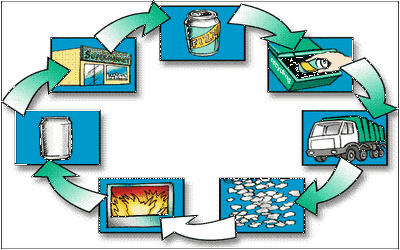
If you are new to yoga or totally clueless about Indian philosophy, I’m
sure the capital letters WTF just popped into your head. Ok, samsara is a Sanskrit word that refers to the cycle of birth, death, and rebirth, while moksha is also a Sanskrit word that means “release.” For the Hindus, they believe that yoga allows the follower to be “released” from samsara. It is equivalent to the Buddhist view of attaining nirvana or enlightenment by being released from dukkha (suffering).
There are many philosophical views regarding this process and I don’t
think they will all fit in this post, so let me just explain this
figuratively in order to make it simple.
Sometimes, when I think about the world we live in, I see it as a huge
manufacturing/recycling plant just like Coca-Cola. However, instead of
producing soft drinks and recycling aluminum cans, the world creates
human beings so that they can be used again and again for a specific
purpose. In this world, our soul is the soft drink and the beverage can
is the body.
Now, just like the brands of soft drink that have their own mix of ingredients, souls have their own karma
(consequences of past actions). When we are manufactured
(reincarnated), our karma tells us what kind of life we will have just
like how a can of soft drink is labeled depending on its flavor, its
nutritional value, its calorie content, and so on. After that, we get
distributed depending on where we need to go.
The problem with this process is that, after being recycled and given a
new body, the person again experiences all the beating that life has to
offer, he/she grows old, and becomes useless when the purpose has been
fulfilled without even realizing what it was really all about.
Does it always have to be like that? Should you spend the rest of eternity like a small can of soda?
Well, according to the esoteric religions, it doesn’t have to be like
that for everyone. You can get yourself out of that cycle. However, not
everyone is spiritually mature to realize this truth since everyone is
in their own stage of spiritual development. That is why the esoteric
(hidden) knowledge, like the teachings of yoga, is only available to
those who are spiritually ready to grasp its true meaning. Indeed, even
if the information is available, you will not understand it unless you
are already capable of receiving it.
Main Branches of Yoga
The yogis in India say that there is always a particular path best
adapted to the requirements of each individual soul who seeks to attain
higher consciousness. This means that any person may take a different
path, but all paths lead to the main road that is headed for only one
place - the union with the divine spirit.
If you try to observe everyone around you, you will notice that almost
all of the people you know or do not know have dedicated their lives to a
certain purpose. For example, some people like soldiers, charity
workers, doctors, housewives, and so on have chosen to serve others
unselfishly, some people like scientists, philosophers, explorers, etc.
have chosen a life dedicated to the pursuit of knowledge, and some
people like priests, nuns, monks, and the like have chosen to devote
themselves to worshipping God.
As you can see, everyone seems to be doing their own thing. However, no
matter what the case may be, we are all here to learn from our
experiences, and it is the knowledge and wisdom that we get from these
experiences that enriches our soul.
1. Raja Yoga (classical yoga)
Raja Yoga is the path followed by those who feel inclined to develop spiritual powers
latent in all of us. However, it is not only about that. Raja yoga, to
be more exact, is about the gaining of the control of the mental
faculties by the will, the attainment of the mastery of the lower self,
and the development of the mind to the end that the soul may be aided in
its illumination. There are eight phases that an individual must
observe in practicing Raja yoga which includes: abstentions,
observances, postures, breath control, abstraction, concentration,
meditation, and finally liberation.
2. Karma Yoga (selfless action)
The word "Karma" comes from the Sanskrit word "Kri" meaning "to do" or "to act." The spiritual law of cause and effect is known in the east as Karma. Karma yoga
is the yoga of work or the path of action. Basically, those who follow
this path take part in the great game that we call "life" by going
through its motions and by doing the best thing possible but all the
time remembering that they should not allow themselves to become
attached to the fruits of their work. They care little for results
although they may feel a keen interest in the game while it is being
played.
3. Jnana Yoga (knowledge/wisdom)
The word Jnâna is a Sanskrit word that means “knowledge." Jnana yoga
is the yoga of wisdom or can also be called “the path of knowledge.”
Those who are attracted by metaphysical reasoning and speculation,
subtle intellectual research, philosophy, science, and similar lines of
mental effort, turn naturally to Jnana yoga. However, you need not be
skilled in any particular school of thought to avail yourself of the
lessons that this branch of yoga provides. As long as you wish to know
the "why" of life and as long as you are, by nature, called upon to seek
knowledge of the esoteric, you are doing Jnana yoga.
4. Bhakti Yoga (devotion)
Bhakti yoga is the yoga for those who prefer to grow into an
understanding and union with the "Absolute" or "God." In other words,
anyone who recognizes the love and worship of any conception of God is
performing Bhakti yoga. We all know that people have varying beliefs
regarding God and this may seem to be a hindrance because of the fact
that there are certain individuals who take advantage of other people's
ignorance (like what we see in most religions of today). However, it is
believed in the philosophy of Bhakti yoga that no matter what kind of
deity you worship, underneath it all you are still obeying the religious
instinct that will in time lead you to the knowledge of the highest
attributes of the one and absolute God.

So there you have it folks. Welcome to the world of yoga and higher consciousness. This seems to be too much for one article though I’ve barely scratched the surface of this spiritual tradition. There is still a lot more to discuss so please stay tuned. If you want to be updated, feel free to subscribe. Peace out!