You know what? When I started to seriously ask
myself the question, “Who am I?”, my mind began to open up to a lot of
things. Ever since I began studying the spiritual aspects of man, I
learned that beyond my physical body, which I see every time I look at
the mirror, there are actually things that are kept hidden from my
awareness. That is why, today, I’m going to discuss one of those things
with you, and it is called spiritual energy centers or the 7 chakras.
 What Are Chakras?
The word chakra is derived from the Sanskrit word “cakra” which means “circle” or “wheel.” When the energy flowing through the nadis (energy channels) intersect at the chakra centers of the subtle body, they form wheel-like vortices (hence, the origin of the name).

In spiritual and religious traditions, they have what is called the subtle body
(a.k.a. astral body) which is what we use whenever we travel within the
astral plane (or dream world) during our sleep and the mental realm in
lower meditative states. Notice that when you are dreaming, your body
feels lighter than usual and it seems that it can do almost anything and
go almost anywhere. The reason is that, in the astral realm, there are
no limits. It is the realm of the mind and whatever the mind conceives
becomes true within that realm.
The subtle body rests in our physical body whenever we are awake. These
two bodies need to integrate during the waking state in order for us to
be able to function in the physical world. Otherwise, without the subtle
body resting in your physical body, you are as good as dead for there
is no mind holding you together.
Incidentally, the mind needs to run energy through the physical body to
make it function. Hence, the subtle body must have corresponding
channels in the physical body where it can allow energy to flow. These
channels are called Nadis (channels that carry life force
energy known as prana in Sanskrit, or qi in Chinese traditions). You may
think of the nadis as the invisible counterparts of the sympathetic,
parasympathetic, and central nervous system. The nadis run along the
spinal column in a curved path and cross one another several times. At
the points of intersection they form strong energy centers known as
chakras.

Now, of course, the energy that we find in the chakras is not visible to
the naked eye, and this is why it’s hard for some people to accept the
existence of these energy centers. However, do take note that there are
other forms of energy (like gravitational, electromagnetic, sound, and
thermal energy) that we also do not see with our eyes but we obviously
recognize because science tells us they do exist.
Ok, for the sake of science, let me try to invoke Einstein’s spirit for a moment and see if I can channel a bit of his genius:
A Chakra is said to have physiological relations to 1.) Nerve plexus - a network of intersecting nerves containing neurotransmitters which are situated in the region of the spinal cord and 2.) Endocrine glands - glands that secrete hormones which are also situated in the region of the spinal cord.
A neurotransmitter is a compound released from a nerve terminal which carries signals to different parts of the body. A hormone,
on the other hand, also carries signals but takes a different path,
i.e. the bloodstream. Neurotransmitters and hormones basically contain
the same thing, i.e. chemicals. Now, if chemicals are composed of atoms
(the basic unit of matter), and atomic particles contain energy, then
don’t you think we’re going to arrive at something here?
Yes! Obviously, we move in the physical world because of the energy
in the atomic particles that assemble into chemicals that compose the
neurotransmitters and hormones found in the nerve plexuses and endocrine
glands of our body. Simply put, both the nerve plexuses and endocrine
glands transmit ENERGY. Tadaa! Well, I’m sure my naïve
understanding of neuroanatomy, endocrinology, and atomic physics won’t
even impress a fifth grader, but hey, I’m just channeling Einstein.
Anyway, it must be remembered that these are only physical
correspondences; just as the ordinary human brain is the registering
organ of memory, but not memory itself. The 7 chakras are not
perceptible to our gross senses.
Even if they were perceptible in the living body which they help to
organize, they disappear with the disintegration of the human organism
at death.

In many spiritual traditions, it is believed that consciousness
manifests itself as energy. Since we already established the fact that
the chakras are energy centers found within the body, we can say,
therefore, that consciousness rest in these energy centers as well. You
may have been led to believe by your culture that the seat of
consciousness is the human brain. However, that is not the case with
regard to esoteric knowledge. Consciousness can be divided into several aspects including, but not limited to, the following: survival and security, sexuality, emotional intelligence, intellect, personality, creativity, intuition, and wisdom.
Each of these consciousness aspects is said to rest on its
corresponding energy center as you will see when we later discuss each
of the 7 chakras.

The 7 chakras are associated with different colors among which are the
following: red, orange, yellow, green, blue, indigo, and violet. The
colors play an important role when activating a chakra through the visualization technique primarily because each chakra responds to a particular spectrum of light (electromagnetic spectrum).
It is important to mention that light, as we all know, is another form
of “energy.” So, if you are dealing with energy, like that found in the
chakras, then you might as well use energy to control it which, in this
case, takes the form of light. In other words, “Fight fire with fire.”
It doesn’t really take an Einstein to figure that out.
But what’s most intriguing about light and the various colors of the
electromagnetic spectrum is that they produce certain effects on the
physiological and psychological functions of the human body. Advertisers
know very well that the colors red and yellow make you want to eat
spaghetti that came from McDonald’s even if you don’t want to, don’t
they?
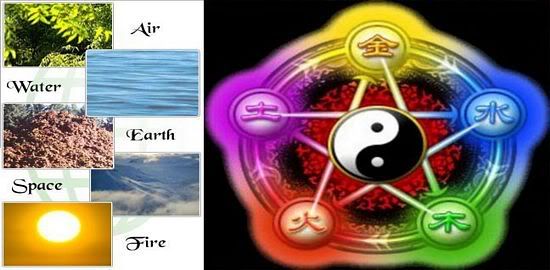
In Greek, Hindu, and Buddhist philosophy, it is believed that there are
five elements that are extremely important in the study of nature,
namely Earth, Water, Air, Fire, and Aether/Ether.
The secrets of the higher worlds as well as spiritual powers are said
to be given to anyone who understands these elements and the principles
that they hold. Five of the lower chakras, beginning from the Root
chakra, correspond to these elements.

Chakras are oftentimes symbolized by the lotus flower. The lotus plant
signifies the growth of man through the three periods of human
consciousness--ignorance, endeavor, and understanding. As the lotus
exists in three elements (earth, water, and air) so man lives in three
worlds--material, intellectual, and spiritual. As
the plant, with its roots in the mud and the slime, grows upward through
the water and finally blossoms forth in the light and air, so the
spiritual growth of man is upward from the darkness of base action and
desire into the light of truth and understanding. The water serves as a
symbol of the ever-changing world of illusion through which the soul
must pass in its struggle to reach the state of spiritual illumination.
Like all beautiful flowers, the lotus represents spiritual unfoldment
and attainment. Hence, the Eastern gods, buddhas, boddhisattvas, and saints are often shown seated upon the open petals of the lotus blossoms.
 Each
lotus flower has a certain number of petals depending on the chakra
that it represents. The petals of the lotuses vary, being 4, 6, 10, 12,
16 and 2 respectively, commencing from the Root chakra and ending with
Crown chakra. It may be asked, “Why do the petals vary in number?” Why,
for instance, are there 4 in the Root chakra and 6 in the Sacral chakra?
The answer is that the number of petals in any chakra is determined by
the number and position of the nadis or energy channels around that
chakra. Thus, four nadis surrounding and passing through the vital
movements of the Root chakra give it the appearance of a lotus of four
petals which are thus configurations made by the positions of nadis at
any particular center.
Each
lotus flower has a certain number of petals depending on the chakra
that it represents. The petals of the lotuses vary, being 4, 6, 10, 12,
16 and 2 respectively, commencing from the Root chakra and ending with
Crown chakra. It may be asked, “Why do the petals vary in number?” Why,
for instance, are there 4 in the Root chakra and 6 in the Sacral chakra?
The answer is that the number of petals in any chakra is determined by
the number and position of the nadis or energy channels around that
chakra. Thus, four nadis surrounding and passing through the vital
movements of the Root chakra give it the appearance of a lotus of four
petals which are thus configurations made by the positions of nadis at
any particular center.

It is said that spiritual visions appear before the mental eye of the
skilled practitioner of secret traditions. New worlds with indescribable
wonders will unfold themselves before your eyes, planes after planes
will reveal their existence and grandeur to you, and you can even attain
divine knowledge, spiritual powers, psychic abilities,
and bliss, in increasing degrees. This is the secret of the 7 chakras -
a secret that most of us in modern society do not and will not know
unless we stop focusing on the material world and start paying attention
to the spiritual world.
There are many ways to awaken each or all of the 7 chakras and various spiritual traditions throughout the world probably have their own techniques. So far, I’m only familiar with the methods that you see below. If you want to read a short description of these methods, please check out my article about the subconscious mind. Otherwise, click on the links below to learn more.
1. Pranayama or Breath Control
2. Visualization Techniques
3. Mantras
4. Yoga Asanas (postures)
5. Entheogenic plants
6. Psychedelic drugs
7. Kundalini Yoga
 | Location in the body: The last bone in spinal cord |
|---|---|
| Physical Correspondence: Coccygeal Plexus and Adrenal Glands | |
| Consciousness Aspect: Survival and Security | |
| Color: Red | |
| Corresponding Element: Prithvi (Earth) | |
| Number of Petals: 4 | |
| Stimulant: Opioid drugs | |
A primordial cosmic energy called Shakti lies coiled and latent at the base of the spine or the Muladhara chakra. Through the practice of Kundalini yoga and other similar techniques, anyone can awaken this energy and enable it to rise to the higher chakras until it reaches the crown of the head where the Sahasrara chakra is located. When this is accomplished, one will be able to experience the highest and purest state of consciousness or eternal bliss. Otherwise, the mind of a worldly man (like George W. Bush) can only move along base desires and passions.
2. Swadhisthana - Sacral Chakra
 | Location in the body: Ovaries/Prostate |
|---|---|
| Physical Correspondence: Sacral Plexus and Gonads | |
| Consciousness Aspect: Sexuality, Emotional Intelligence | |
| Color: Orange | |
| Corresponding Element: Apah (Water) | |
| Number of Petals: 6 | |
| Stimulant: Alcohol(in moderate quantities) | |
The Sacral chakra is a center for emotions and gender identity. A balanced Sacral chakra is said to help in controlling reproductive and emotional issues which include addiction, obsessive behavior, sexual anxiety, genital problems, intimacy issues, fertility issues, and so on.
3. Manipura - Solar Plexus Chakra
 | Location in the body: Navel area |
|---|---|
| Physical Correspondence: Solar Plexus and Pancreas | |
| Consciousness Aspect: Rationality, Intellect, Personality, Power | |
| Color: Yellow | |
| Corresponding Element: Agni (Fire) | |
| Number of Petals: 10 | |
| Stimulant: Caffeine, Amphetamines, High protein diet | |
Once your mind becomes purified and rises to the Manipura chakra or the center in the navel through practice of the techniques I mentioned earlier, you will be able to experience some power and joy. The Manipura chakra is also said to be the seat of Pasyanti (subtle inner vision) - a state where language has the vibrating homogeneity of sound. When this chakra is highly active, a person can see words which have color and form. Does the word synesthesia ring a bell? Check out The Boy With The Incredible Brain.
4. Anahata - Heart Chakra
 | Location in the body: Heart area |
|---|---|
| Physical Correspondence: Cardiac and Thymus gland | |
| Consciousness Aspect: Sensori-Emotional, Aesthetic | |
| Color: Green | |
| Corresponding Element: Vayu (Air) | |
| Number of Petals: 12 | |
| Stimulant: MDMA, Yoga, Tantra, and the entheogenic plant Cannabis | |
When the mind rises to the Anahata chakra or the center in the heart, one experiences bliss and visualizes the effulgent form of the Ishta Devata (a worshipper's favorite deity). In my case, my favorite guy is the Buddha, obviously. That is why I find it important to focus on the heart chakra when I practice so that I can one day have a word with him. When the heart chakra is agitated, however, people lose touch with feelings and sensations. This in turn breeds the sense of dissatisfaction which then causes a person to look outside for fulfillment.
5. Vishuddha - Throat Chakra
 | Location in the body: Throat and Neck area |
|---|---|
| Physical Correspondence: Pharyngeal Plexus and Thyroid gland | |
| Consciousness Aspect: Creativity | |
| Color: Blue | |
| Corresponding Element: Akasa (Aether or Ether) | |
| Number of Petals: 16 | |
| Stimulant: Mantras | |
When the mind gets highly purified and when meditation and devotion become intense and profound, the mind rises to the Visuddha chakra or the center in the throat. It is here where one experiences more and more powers and bliss. The throat chakra is connected to creativity and language primarily because it is here where we produce sound, and sound, according to spiritual traditions, is the manifestation of divine creation. Isn’t it that we use sound when we use language, and we use language to create reality? The Aum mantra works well for this energy center. Nonetheless, please take note that even when the mind has reached this center, there is a possibility for it to come down to the lower chakras.
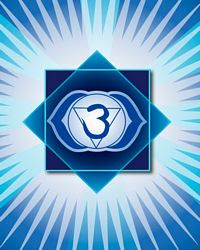
6. Ajna - Brow or Third Eye Chakra
 | Location in the body: The Eyebrow region (Third Eye) |
|---|---|
| Physical Correspondence: Cavernous Plexus, Pineal Gland | |
| Consciousness Aspect: Intuition | |
| Color: Indigo | |
| Corresponding Element: Manas, Citta, or Mind (Ajna is the center of Mind) | |
| Number of Petals: 2 | |
| Stimulant: Pranayama, Mantras, and the psychedelic drug called LSD | |
Ahh, yes… the third eye! Did you know that in the esoteric philosophy called Theosophy, they believe that the earliest humans that inhabited the planet (millions and millions of years older than our race) did, in fact, possess a fully functioning third eye? Legend, indeed, has it that humans have been on Earth earlier than what modern archaeology suggested and there are many scientific explorers out there who are trying to prove it.
Anyway, as I have said, the "third eye," for the early humans, was once a physiological organ. It later on atrophied owing to the gradual disappearance of spirituality and increase of materiality. Nonetheless, when the student of yoga or other forms of spiritual practice reaches the Ajna Chakra or the center between the two eyebrows, he attains Samadhi (a non-dualistic state of consciousness in which the consciousness of the experiencing subject becomes one with the experienced object). That is why when you are in a state of trance while watching the auditions for American idol and someone makes you LOL, try to avoid being judgmental. For all you know, it could be that you’re actually laughing at yourself.
7. Sahasrara - Crown Chakra
 | Location in the body: Top of the head; 'Soft spot' of a newborn |
|---|---|
| Physical Correspondence: Upper Cerebrum and Pituitary Gland | |
| Consciousness Aspect: Wisdom | |
| Color: Violet | |
| Corresponding Element: Yourself (Sahasrara is the center of Pure Consciousness) | |
| Number of Petals: 1000 | |
| Stimulant: Psychedelic drugs (LSD, Ketamine, DMT) | |
Ok, this is the last and the highest of the 7 chakras. It is said that once you reach the spiritual center in the brain, the Sahasrara chakra (a.k.a. the thousand-petalled lotus), you attain Nirvikalpa Samadhi or the superconscious state. You become one with the eternal, unchanging, infinite, immanent, and transcendent reality which is where matter, energy, time, space, being, and everything beyond our awareness all exist as one. All sense of separateness dissolves and you realize that the entire Universe is actually - YOU.